



Eagle Eye Networks pricing is quoted through its partners as a cloud subscription, and the company does not publish list prices on its site.
We make Visylix. Every Eagle Eye fact below comes from Eagle Eye's own pages, checked on 15 November 2026.
What are Eagle Eye Networks?
Eagle Eye Networks makes a cloud video management system. It describes its solutions as 100% cloud managed, with flexible pricing plans, analytics and an open RESTful API, sold through channel partners (een.com/company, checked on 15 November 2026).
In December 2025, Brivo and Eagle Eye Networks announced a merger under the Brivo name. Eagle Eye founder Dean Drako became CEO of Brivo (brivo.com, checked on 15 November 2026). The video product is now sold as Brivo Eagle Eye Video.
Brivo says the product works with more than 8,000 cameras and offers natural language search and gun detection alerts. Analytics run on the edge or in the cloud (brivo.com, checked on 15 November 2026). It also states SOC 2 compliance and triple redundant cloud storage.
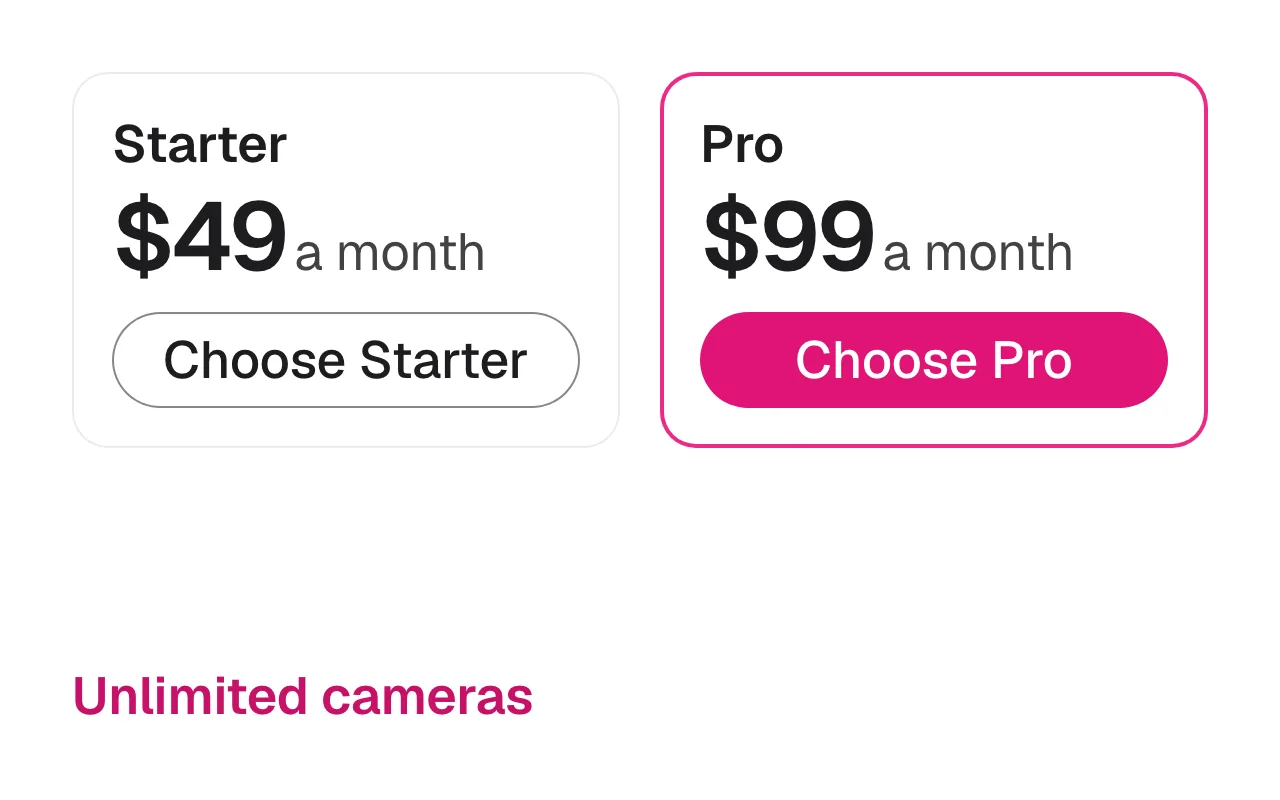
Eagle Eye Networks is a cloud video management system. It links cameras at each site to its cloud through a bridge box, and sells subscriptions through its partners. Eagle Eye does not publish list prices on its own site, so buyers get a quote. Visylix publishes its prices: Starter is $49 and Pro $99 a month.
Eagle Eye is a video surveillance as a service model; our VSaaS explained guide covers how that model works.
Where is Eagle Eye Networks based?
Eagle Eye says it was founded in 2012 and is headquartered in Austin, Texas, with offices in Amsterdam, Bangalore and Tokyo (een.com/company, checked on 15 November 2026).
After the merger, the combined company lists headquarters in Bethesda, Maryland and Austin, Texas, plus offices in Lehi, Amsterdam, Bangalore and Tokyo (brivo.com, checked on 15 November 2026).
How Eagle Eye Networks pricing works
Eagle Eye does not publish list prices on its site. It mentions flexible pricing plans and sells through a global network of channel partners (een.com/company, checked on 15 November 2026). So the price you pay comes from a partner quote.
Hardware is part of the bill. Each site needs an Eagle Eye Bridge, an on site device that connects cameras to Eagle Eye's cloud with local buffering and encrypted upload (een.com, checked on 15 November 2026).
| Model | Maximum 4 MP cameras | Notes |
|---|---|---|
| 304+ | 20 | Compact, extended temperature range |
| 305 | 12 | Compact, four built in PoE ports |
| 406+ | 35 | Compact, licence plate recognition support |
| 504+ | 50 | High level model |
Sites that must keep video on site use a Cloud Managed Video Recorder instead. It connects cameras to the cloud like a bridge, and also stores video locally (een.com, checked on 15 November 2026).
Ask the partner what is charged per camera and how retention changes the price. Ask which analytics cost extra, and what the bridge at each site costs.
How much does it cost to store security camera video in the cloud?
Four things drive cloud storage cost: resolution, frame rate, the number of days you keep, and the number of cameras. Double any of them and the storage roughly doubles.
A 4 MP camera recording around the clock produces far more data than one recording on motion. So ask every vendor whether its price assumes continuous or event recording, and at what quality.
Eagle Eye lets customers store video in the cloud, on premise or both (brivo.com, checked on 15 November 2026). Cloud retention is usually the line that grows fastest, so price 30, 90 and 365 days separately.
Cloud VMS costs grow with every camera and every extra day of stored video. The subscription is per camera, and storage sits in the vendor's cloud. Visylix Starter and Pro put no cap on cameras on the VMS licence, and recordings go to your own storage. AI comes with Enterprise, on the cameras you choose.
A cost model you can fill in
| Item | Eagle Eye | Visylix Pro |
|---|---|---|
| Cameras | Your count | Your count, no cap on the VMS licence |
| Retention | Per your plan | Your own storage |
| Sites | Bridge hardware at each | Servers you choose |
| Analytics | Per your plan | With Enterprise, on the cameras you choose |
| Software a year | Your quote | $1,089 |
Our guide to VMS pricing per camera licence shows how to compare the totals over three to five years.
The alternative: a flat VMS licence on your own servers
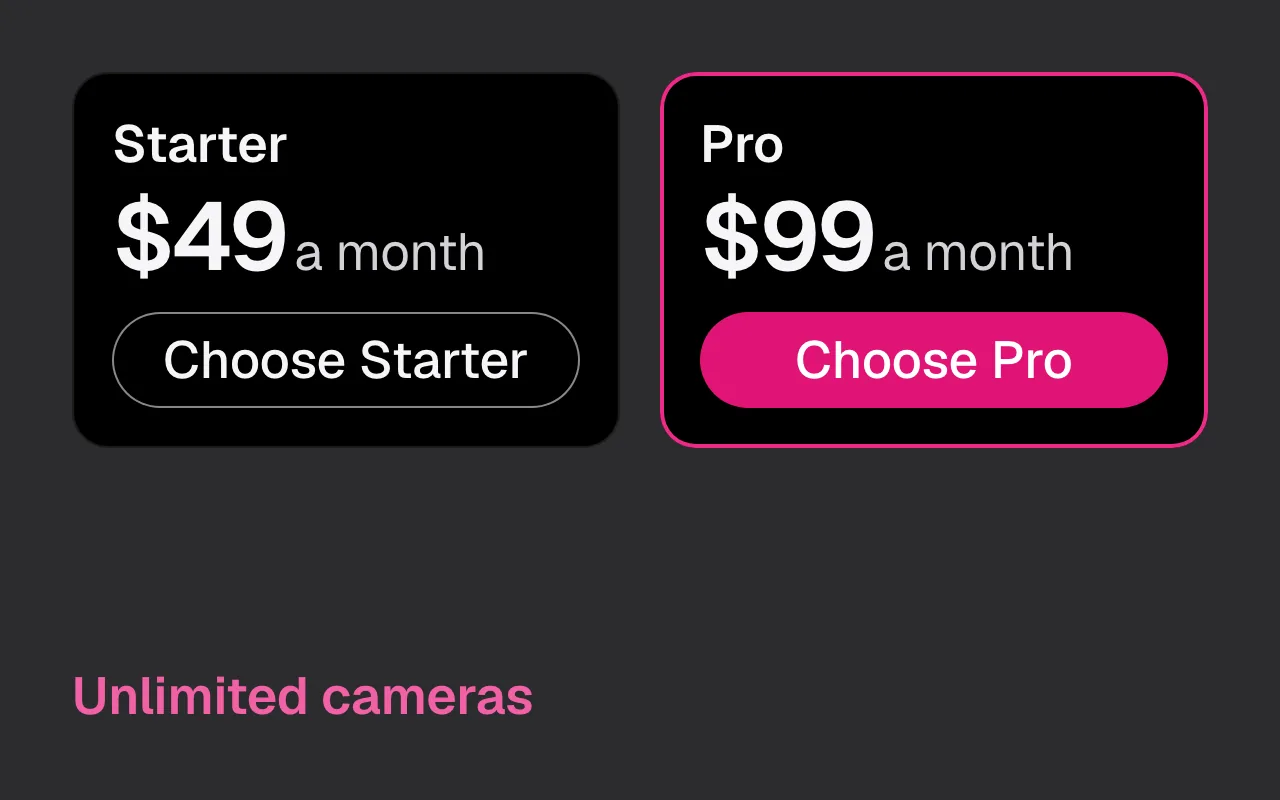
Visylix Starter is $49 a month (₹4,999 in India) and Pro is $99 a month (₹9,999), both with unlimited cameras on the VMS licence. AI analytics come with Enterprise, on the cameras you choose, and Enterprise is priced to your estate. Recording goes to your own storage, so long retention does not carry a cloud premium, and local AI avoids sending all video out for analysis.
Recordings go to storage you own, so retention is a disk decision, not a subscription tier. Across many sites, multi site federation gives one view while each site keeps its own archive.
Deployment choice and edge AI
Eagle Eye describes its solutions as 100% cloud managed (een.com/company, checked on 15 November 2026). Local viewing keeps working when the internet fails, through the bridge or recorder on site (brivo.com, checked on 15 November 2026). Setup, management and cloud storage still depend on the vendor cloud.
Visylix runs on premise, at the edge, hybrid, fully air gapped or in your own cloud account, managed as one estate. At the edge, AI runs on a small server at each site, and only alerts and clips travel to head office. That saves bandwidth and keeps video local. Sites with weak internet keep working, and air gapped sites get the full product with an offline licence.
For estates that mix city offices with remote industrial sites, Visylix adapts to each location. It ships as a Docker image on hardware you choose, and live view runs in any modern browser in under a second over WebRTC.
Our comparison of cloud vs on premise video surveillance sets out the trade offs, and deployment options shows every way Visylix runs.
AI analytics and multi-site management
Visylix has 22 AI analytics developed in house, on Enterprise on the cameras you choose. They cover face recognition, person tracking, unique person counting, crowd detection, pose estimation, tailgating, queue and wait time, and heat maps. They also read number plates with exact plate journeys, and cover parking occupancy, speed, intrusion, line crossing, weapons, fire and smoke, and PPE. The rest handle abandoned objects, camera tampering, object detection, motion, anomalies and audio events. Each camera learns its own normal, and false alarm feedback tightens thresholds automatically within the limits you set.
Brivo Eagle Eye Video offers AI search for people, vehicles and objects, alerts for restricted areas and hotlisted vehicles, and gun detection (brivo.com, checked on 15 November 2026). That covers common needs well, managed from its cloud.
Where the AI runs matters too. Visylix runs AI at the edge, in your server room or in your own cloud account. You choose for speed, bandwidth and data sovereignty at every site.
Visylix gives the same central view with a twist: each site can run the way that suits it. Head office on premise, a data centre in your own cloud account, a remote warehouse at the edge with local AI. All appear in one console, with access controlled per location through 46 permissions across 4 roles. Floor plan and geographic maps, an alarm console and a device health console complete it.
Both work with ONVIF cameras, avoiding the hardware lock in of closed platforms. Visylix connects to cameras directly over ONVIF and RTSP, with no bridge box required at each site, which saves hardware and upkeep across large estates. It can even read archives on Hikvision, Dahua, Uniview, I8H, Bosch and Panasonic recorders.
Already using Brivo access control? Visylix takes Brivo door events through a native connector and combines them with video in its rules. See integrations.
When to choose Eagle Eye, and when to choose Visylix
Choose Eagle Eye if you want a cloud VMS run by the vendor, have reliable internet everywhere and your analytics needs fit its catalogue.
Choose Visylix if you want deep AI that acts, on your own servers, with published prices and no cap on cameras on Starter and Pro. Visylix is never a hosted cloud: it runs on infrastructure you control. See pricing.
FAQ
How is Visylix different from Eagle Eye Networks?
Eagle Eye is a cloud VMS that connects each site through bridge hardware and manages video from its cloud. Visylix runs on infrastructure you control: on premise, at the edge, hybrid, air gapped or in your own cloud account. It brings 22 AI analytics developed in house.
Is Eagle Eye Networks part of Brivo now?
Yes. Brivo and Eagle Eye Networks announced their merger on 29 December 2025, and the combined company operates as Brivo (brivo.com, checked on 15 November 2026). The video product is now called Brivo Eagle Eye Video.
Can Visylix match Eagle Eye for multi site management?
Yes. Visylix manages every site from one console, with access scoped per location, maps, an alarm console and AI across the estate. Eagle Eye lists solutions for retail, restaurants, hotels and logistics (een.com, checked on 15 November 2026). Visylix gives you the same central control without sending your video to someone else's cloud.
Which is cheaper for a 500 camera multi site deployment?
Model both at your camera count and retention. Eagle Eye quotes through its partners. Visylix Starter and Pro include unlimited cameras on the VMS licence at $49 and $99 a month. Recordings go to your own storage, and AI comes with Enterprise on the cameras you choose.
Does Eagle Eye support on premise deployment?
Eagle Eye describes its solutions as 100% cloud managed (een.com, checked on 15 November 2026). Video can be stored on site on its recorder, but management runs in its cloud. Visylix treats on premise, hybrid, edge and fully air gapped deployment as standard options.
Is the AI analytics story comparable?
Brivo Eagle Eye Video offers AI search, area and vehicle alerts and gun detection, managed from its cloud (brivo.com, checked on 15 November 2026). Visylix has 22 AI analytics developed in house, from face and plate recognition to PPE, fire and smoke, crowds and pose, on your own servers.
When should I stay with Eagle Eye?
If you run Eagle Eye across many sites with settled workflows and like a vendor cloud, moving may not pay off yet. For new projects, and anywhere on premise or air gapped operation is required, Visylix deserves a serious look.
Sources
This guide supports Deployment options on the Visylix platform.